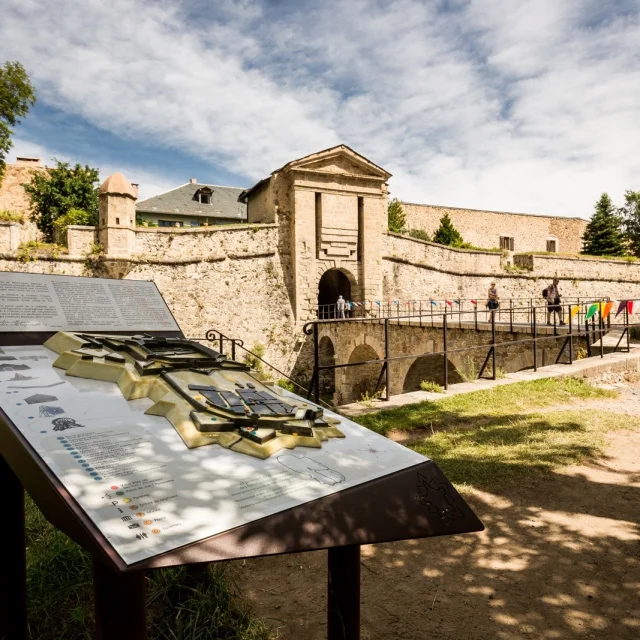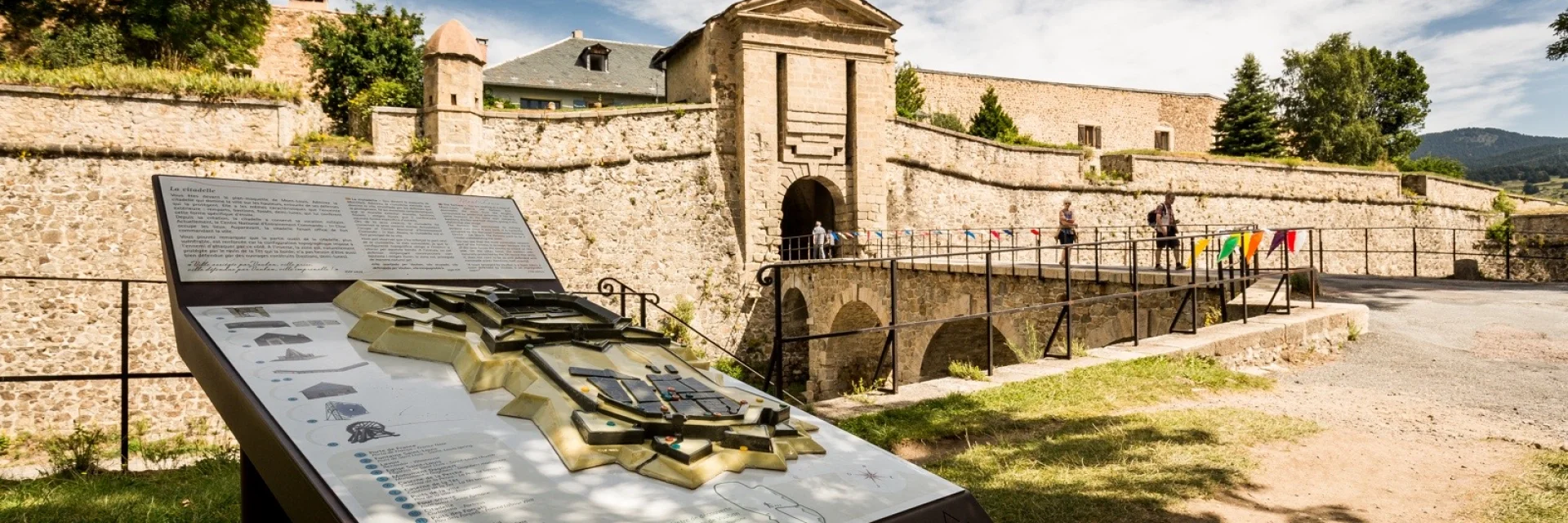
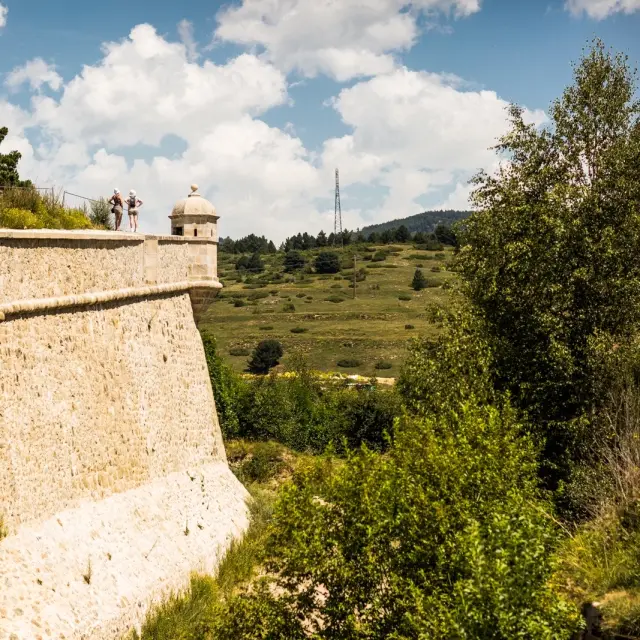
The fortified entrance to the town of Mont-Louis, a UNESCO World Heritage Site, showing the ramparts and access bridge typical of Vauban’s fortifications.
©

Mont-Louis, a fortified town listed as a UNESCO World Heritage Site. A Vauban town.

|

© Jc Milhet

Mont-Louis: explore Vauban's fortress and its hidden treasures

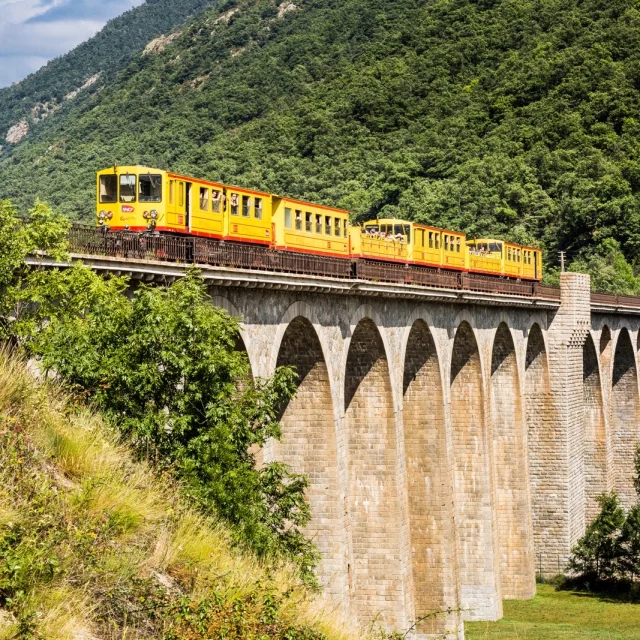
Mont-Louis is one of Vauban’s jewels on UNESCO’s World Heritage List. With its star-shaped ramparts, Saint-Louis church, historic solar oven and working citadel, this must-see stop on the Train Jaune combines heritage, military history and unusual sights. Follow me on a guided tour to discover the “City of the Sun King”, a real treasure of the Pyrénées-Orientales.

Brice

This is Brice, the team rugby player. A real joker who's always in the mood. For this bon vivant, the most important thing is never to skip a meal, because "better than reason, the stomach directs us". Keen on wide open spaces and freedom, he'll guide you to the four corners of the département for terroir walks that only he knows the secret of. So pack your rucksack and head off with Brice for a breath of fresh air.

Stroll through the narrow streets the smallest commune in the department

Discovering Mont-Louis

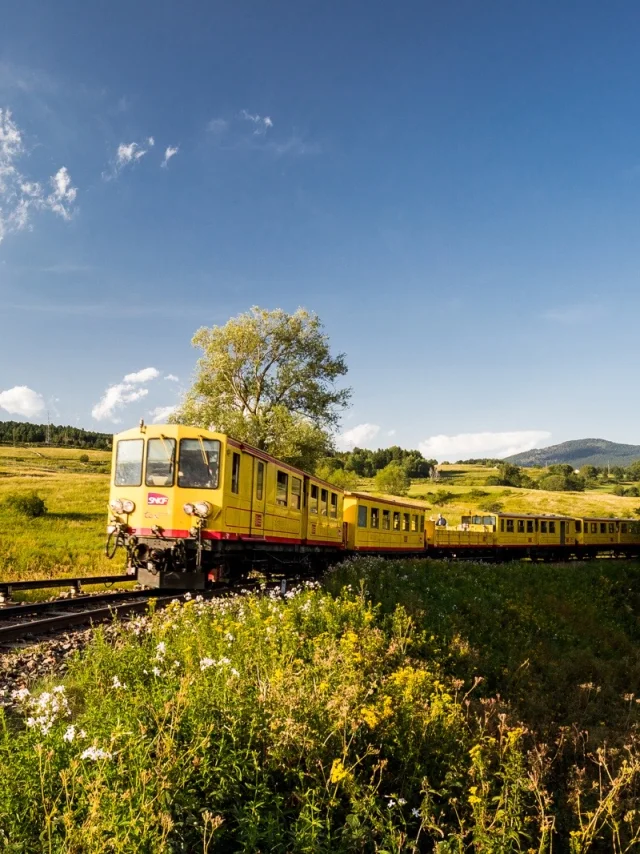
I’m back in the Haut-Conflent region to take you on a tour of the Mont-Louis citadel! A must-see stop on the Yellow Train, it has been a UNESCO World Heritage Site since 2008. Of the 160 Vauban squares, only 12 are listed.

After passing through the Porte de France and then the Porte Royale, I took advantage of the few minutes that separated me from the start of the tour to wander through the narrow streets of the smallest commune in the department and one of the 10 smallest in France. To start with, I had to pause for a moment to admire the church of Saint-Louis, an architectural gem dedicated to a grandfather of Louis XIV. It was built in 1733 at the request of the local inhabitants on the model of the church on the citadel. Frankly, it’s well worth a look. I then took the opportunity to take a souvenir photo in front of the fountain of the same name.
The historic solar oven

I made a short diversions to contemplate the very first solar oven, which was installed in the 1950s in the northern part of the citadel. The engineer Félix Trombe made Mont-Louis the cradle of solar energy and gave it back its name of “City of the Sun King”. The solar furnace is currently located on one of the town’s bastions and tours are organised there.
Good to know

Mont-Louis, nicknamed the “City of the Sun King”, owes its name to Louis XIV, who ordered its construction in 1679 to protect the border after the Treaty of the Pyrenees. The highest fortified town in France (1,600 m above sea level), it is also the smallest commune in the département in terms of surface area. Listed as a UNESCO World Heritage Site alongside 11 other Vauban sites, Mont-Louis is still home to an active military centre and France’s very first experimental solar furnace.

The secrets of the citadel de Mont-Louis

Vauban and military strategy

With time running out, I headed off to the meeting point to meet Sylvie, our guide for the day. It’s 11:30 sharp when the tour starts. There’s no question of being late here – time is time when it comes to passing through the gates of a military fortress.

Before starting the tour, let’s take a look at the history of the site. The year was 1679, and Louis XIV asked Sébastien Le Prestre, known as Vauban, then commissioner-general of fortifications, to take over. His mission was to secure the territory annexed to Spain following the Treaty of the Pyrenees in 1659.

Vauban came to reconnoitre, and by March the site had been chosen. The location was strategic, with the Têt valley to the east, the Col de la Perche to the west and the Capcir to the north. In May, the project was approved, work began in June and two years later, on 26 October 1681, the Place de Mont-Louis was inaugurated. All in all, it’s been a busy time!

Sylvie began by explaining the characteristics of the Vauban fortifications. Ramparts, bastions, ditches and half-moons give them their specific star shape. What a masterpiece!

The military compound and the National Commando Training Centre

Once through the gates, no photos are allowed. This is a classified area, where the National Commando Training Centre (CNEC) has been located since 1964. In fact, the regiment is currently one of the lastmilitary units to occupy a structure designed by Vauban. With the motto “Always on the cutting edge”, Sylvie reminds us of the CNEC’s current missions. I put myself in the shoes of a soldier!

On arriving at the parade ground, I was surprised by the sheer size of the place. To be honest, from the outside it’s hard to imagine what you’re about to discover. This parade ground is swarming with soldiers in full activity, no joke. In the distance, I spotted the church, a replica of which I had seen in the town. Sylvie explains that it has not been a place of worship for many years. After having been used for various purposes, the church has now been converted into a gymnasium.

The "convicts' well Anecdotes and curiosities

We continue our tour, crossing the Place d’Armes to a building housing a strange machine. The wall is inscribed with the words “Puits des forçats” (“convicts’ well”). This well was once used as a punishment. For 12 hours, a person would sit in what is known as the “squirrel cage”. The only instructions were to walk, walk and walk some more. The aim was to make the big wheel turn, so that the drum would be activated and bring up the buckets of drinking water.

To make matters worse, the buckets weighed 25 kg empty and held 100 litres. Suffice to say that the 12 hours must have seemed interminable! If I can give you the weight of the buckets today, it’s because on 1 March 2005, at Sylvie’s request, a clean-up operation was carried out in the depths of the well.

A team from the Collioure nautical training centre came along. And to tell you the truth, they must still be angry with Sylvie for having made them dive into water at 4°C. But after bringing a number of objects to the surface, the joy was immense when the divers pulled 4 vintage buckets out of the water. Two dating from the Louix XIV period and two more contemporary ones dating from 1820. They are now on display in this room, along with all the other objects, as well as a model of Vauban’s work.

The day in review

As the tour draws to a close, it’s time for me to thank Sylvie for her clear explanations and anecdotes, which made the visit so rich in discovery. Children are very welcome, as Sylvie does her best to captivate them. I hope this day has inspired you to come and discover this jewel of Catalan architectural heritage, because Mont-Louis is a must-see for any stay in the Pyrénées-Orientales! See you soon for more adventures.

Practical info Mont-Louis

Access: Via Haut-Conflent, 1,600 m above sea level, access by N116 or Train Jaune (Mont-Louis – La Cabanasse stop).

When: Guided tours from April to October, several departures a day.

Price : Adults ~€7, Children aged 6-12 ~€4, free <6 years.

Duration: 1h15 (guided only).

What to bring: Comfortable shoes, no photos allowed in the citadel.

Tip: Arrive in the morning to enjoy the golden light on the ramparts and take your best photos from the Porte Royale.

Preparing your stay

Plan interactif : 1 lieux répertoriés.

  • Lorem ipsum
BIT Mont-Louis

+33 (0)4 68 04 21 97

Do you enjoy this experience? Have you done it yourself and want to share it with your friends?

More experiences in the P.O.